How Much Does Video Production Cost in San Antonio?
If you're thinking about hiring a video production company in San Antonio, you probably have one question before any other:
What is this actually going to cost me?
Here's the honest answer. It depends, and not in the way that's meant to dodge the question.
Professional video production in San Antonio can run anywhere from a few thousand dollars for something simple to well into the tens of thousands for a larger commercial project. That's a wide range, so let's walk through where the money actually goes, why one video costs $5,000 and another costs $50,000, and how to figure out roughly where your project should land.
What Video Production Actually Costs in San Antonio
Most projects fall into a few general ranges.
$3,000 to $7,500: Small Production
Interviews, testimonial videos, simple social content, or a straightforward promotional video. Small crew, one or two locations, a short shoot, and clean, efficient editing.
$7,500 to $20,000: Mid Level Brand Production
This is where most brand films, case studies, recruiting videos, customer stories, and marketing campaigns land. There's more time spent shaping the story before anyone picks up a camera, a bigger crew, real lighting and audio, and a more involved edit once footage comes in.
$20,000 to $50,000+: Commercial Production
Directors, producers, cinematographers, camera operators, lighting and grip crews, sound mixers, talent, multiple shoot days, animation, and a longer post-production process. And yes, it can go well beyond $50,000 depending on scope.
Here's the thing worth remembering: these aren't different prices for the same product. They're different productions, built to do different jobs.
Why Two 60-Second Videos Can Cost Completely Different Amounts
This trips up almost everyone, so let's clear it up early.
Video is rarely priced by the length of the finished piece.
A 60-second commercial might take four hours to shoot. Another 60-second commercial might take three weeks of planning, two shoot days, twenty crew members, six actors, several locations, a drone, custom sets, licensed music, and weeks of editing. Same runtime. Not remotely the same production.
If you want a shortcut for thinking about cost, forget the clock. Think about the resources it takes to make the thing.
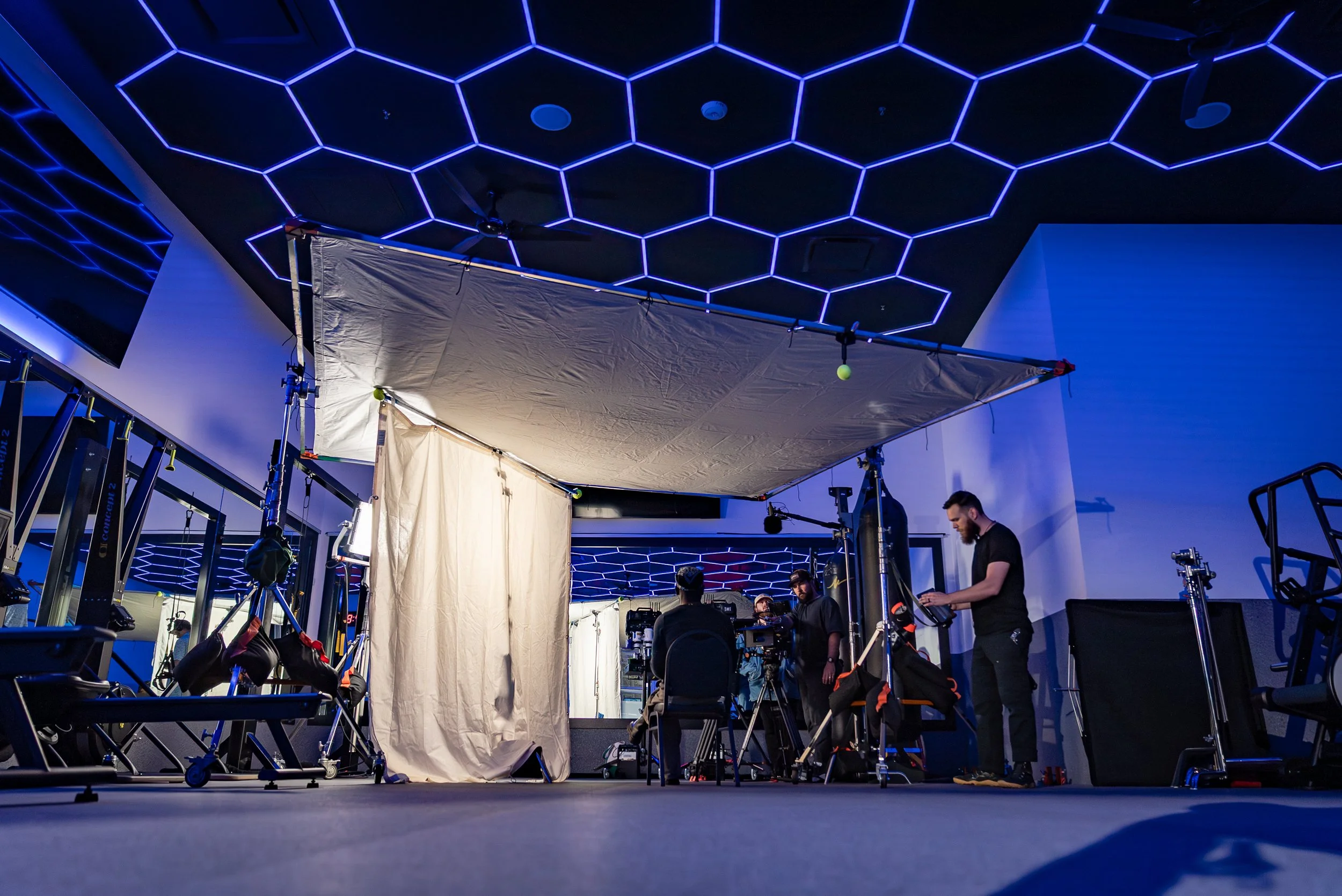
The crew getting set for an interview inside of Club Elite in Arnold, MO
What You're Actually Paying For
When you hire a video production company, you're not just paying someone to show up with a camera. You're paying for everything that happens before and after that moment too.
Strategy and creative development
Before anyone touches a camera, we want to know what the video actually needs to do. Who's watching it? What should they walk away understanding? What should they feel? And most importantly, what do you want them to do after they watch it?
This is where discovery conversations, messaging, concepts, scripts, and storyboards get worked out. It's tempting to rush this part to get to the "real" work, but it's often the smartest place to spend more time, not less. Changes are cheap when they're still just ideas on a page. They get expensive fast once fifteen people are standing around on a set waiting on a decision.
Pre-production
Once we know what we're making, someone has to figure out how to actually pull it off. That covers location scouting, casting, scheduling, booking crew, renting equipment, permits, insurance, shot lists, call sheets, travel, wardrobe, and a dozen smaller logistics.
An interview with your CEO in your San Antonio office is a pretty simple lift. A commercial with five locations, actors, vehicles, and an overnight shoot that shuts down part of a street is a completely different animal, and the budget reflects that.
Production
This is the part everyone pictures when they hear "video shoot": cameras, lights, and action.
Crew size moves the budget more than almost anything else. A small shoot might just need a director who also runs the camera and one or two other hands. A bigger commercial can mean a director, producer, director of photography, camera operator, gaffer, grip, sound mixer, production assistants, hair and makeup, an art department, and a drone operator.
Not every project needs all of that. The goal is never the biggest crew possible. It's the right crew for the idea in front of us.
Equipment
Cameras are just the start. Lenses, lighting, wireless video systems, monitors, microphones, grip gear, dollies, drones, generators, teleprompters, and data storage all add up. More gear isn't automatically better, either. We bring what the project actually calls for, nothing extra.
Post-production
Once the shoot wraps, the project is only partway done. Editing, color grading, sound design, mixing, music licensing, motion graphics, animation, visual effects, captions, revisions, and versioning for different platforms all happen here.
A simple interview can move through editing quickly. A story built from several interviews and days of footage takes real time to shape into something that actually holds together.
What Pushes a Video Budget Higher
A handful of things tend to move the number the most.
More shoot days. Each additional day brings more crew, gear, meals, travel, and coordination with it.
A bigger crew. More ambitious creative usually calls for more specialized people to pull it off.
More locations. Moving a production isn't like tossing a camera in a bag. Every move takes real time to plan and execute.
Actors or professional talent. Casting, usage rights, wardrobe, makeup, and talent fees all add up.
Specialty equipment. Drones, cranes, underwater rigs, and specialty lenses solve a specific creative problem, but they cost more and usually need a certified operator.
Animation and motion graphics. A custom animated sequence can take as long to build as the live footage around it. Simple titles cost far less than a fully animated explainer.
Usage rights and licensing. A video that only lives on your own website is priced differently than one running as a paid ad or featuring licensed music with broad usage rights.
Revision rounds. Most quotes include a set number of revisions. Big changes after color and sound are locked add real time back into the process.
Turnaround speed. A rushed 48-hour edit costs more than the same edit on a normal timeline, for the same reason a rush job costs more anywhere else. It means bumping other work to get yours done first.
How to Think About Your Own Budget
You don't need a finished production plan before you reach out. That's part of what a strategy conversation is for. But a few honest questions will get you close to the right range before you ever ask for a quote.
What is this video actually for? A testimonial for your website and a paid :30 commercial are two very different budgets, even though people call both "a video."
Where will it run? Content for your own site and social channels usually costs less to license than a paid media campaign.
How many locations or people are involved? One office, one person, one afternoon is about as simple as it gets. Every extra location or subject adds real cost on top of that.
Do you need real footage of your team and customers, or would stock and animation do the job? Original, on location footage is usually the right call for brand and customer story videos, since it's what makes them believable. Not every video needs it, though.
What's your timeline? A reasonable runway gives a production room to plan well. A rushed one usually costs more to make up the difference.
What People Usually Ask Us
Does a longer video cost more than a shorter one? Not really. Cost tracks the resources a production needs, not the runtime of the finished piece. A tight 90-second interview can easily cost less than a heavily produced 30-second commercial.
What's included in a typical quote? A solid quote covers strategy and scripting, pre-production planning, the shoot itself, and post-production, including a set number of revision rounds. If a quote doesn't spell out what's covered at each stage, ask. It's the easiest way to compare two bids fairly.
Can I get a video made on a smaller budget? Yes. A smaller budget usually means scoping the project down, fewer locations, a smaller crew, one shoot day, rather than cutting corners on quality. A production partner worth working with will tell you honestly what's realistic for your budget instead of overpromising.
How long does the whole process take? Most projects run about six to nineteen weeks from first conversation to final delivery, depending on scope. Strategy, pre-production, the shoot, and post-production each take real time. Rushing is possible, but it usually costs more.
Want a Real Number Instead of a Guess?
Every project is different, which is exactly why we don't run fixed packages. Tell us what you're making, whether that's one testimonial or a full campaign, and we'll walk you through what it actually takes to do right and what that looks like for your budget.